
Structure of the programme
The Master of Science Agroecology and Sustainable Food Systems is designed as a two-year programme curriculum including a practical thesis project. The programme combines 4 semesters with different options. Semester 1 takes place in Norway at the University of Life Sciences (NMBU), the semester 2 includes different options, and semester 3 is offered at ISARA in Lyon, France. The master thesis (semester 4) will be carried out under the major responsibility of one of two partners, and will be co-supervised by the other partner. The double degree programme is coordinated by a consortium consisting of ISARA, France and NMBU, Norway. For the two-year programme a double degree is delivered.
Semester 1
NMBU, Norway
30 ECTS
Agroecology: Action learning in farming and food systems.
You will:
- Work with stakeholders in real-life farming and food system cases
- Take a holistic, multi-perspective approach to understand and improve ecological, economic and social sustainability of these cases
- Link experiences to relevant theory in pace with the fieldwork
- Train competences that are key to deal with sustainability challenges
- Experience the transformative power of systemic action learning to both agroecosystems and personal life
The course in the first autumn semester
‘Agroecology: Action learning in farming and food systems’ is set up according to two important system levels: the farming system and the food system. Three main themes will be: Production & Ecology & People.
The course consists of experience with real-life cases, lectures, literature seminars, workshops and other activities. Depending on the nature of the activities, they are carried out individually, in groups or in plenary. For the most part, at least one day each week will be kept free of plenary class activity. The two first weeks consist of introductory topics and preparation for a subsequent involvement in real-life cases. Then the courses are thematically and practically structured according to a stepwise process of participatory systems inquiry. The last period consists of oral presentations by students, writing of reports, evaluations and an oral exam. Read more about NMBU programme here!
Case projects
The basis for experiential learning in the course is work in groups of about five students in open-ended cases where the local communities participate in a government-supported project to foster organic farming and food systems locally. The case project encompasses about half of the workload. The students will write for their clients a group report containing description, analysis and suggestions for improving the situation. The students will also write an individual learner document, which is supposed to contain description and reflection on the experiences from the casework and their links to relevant theory. The experiences to be dealt with are those related to the structure and functioning of the farming and food systems (‘content’) as well as those related to the methodology of participatory systems inquiry and action learning (‘process’).
Lectures, literature seminars and workshops
Lectures will be given to provide context and methodology for the casework and to address specific topics on demand as identified by the students. Lectures usually last for about one or two hours. They will often be followed by individual and group work (one to two hours), including a plenary discussion concerning key questions and the relevance of the lecture for the case project. The classroom sessions will normally take place between 9 a.m. and 4 p.m. There will also be a number of student-led literature seminars focused on relevant theory on farming and food systems and on methodology for systems inquiry. In teacher-facilitated workshops in class, the student groups will practice application of selected concepts and methods in their casework.
Plenary reflections
Plenary reflection sessions will take place every week. The main purpose is to link experiences to relevant theory and to enhance group and individual learning.
U1. Agroecology: Action learning in farming and food systems
Course contents:
The course consists of two interlinked parts: a group-based real-life project work and an individual reflection on the project work. The real-life project work includes description, analysis and redesign of farming and food systems. Lectures and seminars deal with agroecology, ecological (organic) agriculture, local and global food systems, systems thinking, learning, action research methodology, interview techniques, visionary thinking, creative problem solving, group dynamics, facilitation, agroecosystems structure and functioning from farm to global scales, sustainability in production, environmental, economic and social perspectives, ecological principles of farming and food systems design, systems ecology, food distribution, consumer issues on food, and food security. Students write one group report for their farmer clients and one for their food system clients. They also write an individual report where they reflect on agroecological issues of the project work as well as their own learning while preparing the group reports.
Learning outcomes:
After completing the course, the students should know how to: – Describe and analyse farming and food systems, – link theoretical knowledge and concrete action, – acquire knowledge about their own learning. Further, the students should acquire: – Knowledge of structure and functioning of conventional and alternative (e.g., organic and local) farming and food systems, – knowledge of links between disciplinary (sub-system) knowledge and systemic (holistic) approaches, – experience with methods for systems analysis and improvement, including assessment of sustainability within a methodology of participatory action research, – the ability to handle complexity and change, – the ability to link theory to real-life situations, – the ability to communicate and facilitate, – the ability to learn autonomously and life long, – experience in dealing with attitudes as part of the agroecosystem and the learning community. Through real-life case studies with focus on change processes, attitudes of both students and actors in the farming and food systems will be made explicit. The students will learn how to deal critically and constructively with attitudes and value-based choices as important system elements. Desirable attitudes of the students: open-minded, critical, spirited, determined, approachable, exploring and communicative.

Semester 2
NMBU, Norway
30 ECTS
Recommended course:
- PAE306 – Agroecology: Action oriented research
- MUA 301 – Urban Agriculture
Elective course:
- BINT306 – Internship
- SDG 300
- Other elective courses (including courses at the university of Oslo)
— OR —
Semester at ISARA France, with following options:
Biodiversity Management in Agroecosystems ; Food and Cities; Food, Health and Sociology; Agricultural and Food Economy : from Global Stakes to Local Projects; Mountains as Challenging areas; as well as research internships and other electives.
— OR —
Mobility in cooperation with ISARA’s partners, for example :
- University of Hohenheim (Stuttgart), Germany
- University of Kassel-Witzenhausen, Germany
- University of Natural Resources and Life Sciences, Vienna, Austria
Semester at NMBU – 30 ECTS
- Recommended course: PAE306 – Agroecology: Action oriented research – (10 ECTS)
- Elective course: BINT306 – Internship: Agroecology (5, 10 or 15 ECTS)
- Other elective courses (5, 10 or 15 ECTS)
– OR –
Students can choose among different partner universities
Goal: To deepen their knowledge in different topics/subjects
Semester focus: Detailed information in specific disciplines that are needed to expand prior knowledge on systems evaluation and design and to become confident professionals. The students will gain specific knowledge, tools and methods depending on the courses offered at the different universities. Please contact the programme coordinator to get more information about the following options as modules at these universities can vary from year to year.
FranceAgro3 cooperating partners for the second semester:
- University of Hohenheim
- University of Kassel-Witzenhausen
- Boku University in Vienna
- NMBU
- ISARA (courses in French or English)
NMBU cooperating partners for the second semester (please check with NMBU the financial conditions):
- Minnesota (USA)
- Nova Scotia (Canada)
- Alberta (Canada)
- CATIE (Costa Rica)
- SLU (Sweden)
- Copenhagen (Danemark)
Please contact the programme coordinator to get more information about the following options as modules at these universities can vary from year to year.
Please be aware that according to the university chosen, you may be asked to pay some semester fee. You will find more information directly on the partner website.
Semester 3
ISARA (France Agro3 member), France
30 ECTS
Project management and application of agroecological science in real-world situations.
- F1: Agriculture and landscape management in a particular agricultural region.
- F2: Agroecological cropping practices.
- F3: World agroecosystems and agricultural use.
- F4: Management of agroecosystems: implications from policies and nature conservation.
- F5: Group project management.
Semester 3: All students enrol at ISARA, Lyon, France
Goal: Learn project management and expand on application of agroecological science in real-world situations. The students will learn to put together theoretical knowledge and past experiences to work in farming and food systems. Courses at ISARA, France will start with a field trip to a selected region in France.
In the first module, students will visit different stakeholders to analyse specific question on landscape and agricultural management such as constraints and potentials of the prevailing cropping and livestock production systems, or landscape and biodiversity management systems.
In the second module, students will gain applied knowledge on different agroecological cropping practices such as conservation tillage, direct seeding, intercropping, cover crops, and biological control.
The third module deals with the world ecosystems and their prevailing agricultural systems, but also with influencing factors such as economy, politics, land tenure or social issues. Students will learn which resource conservation techniques are feasible in the different agroecosystems, but also what role indigenous knowledge of farmers plays in traditional and modern agriculture.
The fourth module deals with the management of agroecosystems and implication from policies and nature conservation. Topics dealt with are for example agri-environmental measures, international conventions impacting agriculture, protected areas and agriculture, and ecological corridors in agricultural landscapes.
The fifth module is a project management.
Semester 4
MASTER THESIS
30 ECTS
Translate knowledge, skills, and experience gained so far into responsible action by conduct of an independent, scientific research on priority issues in the agricultural and food sectors.
(Number of credits: 30 ECTS)
The Master’s thesis is made during the 4th and last semester of the MSc Agroecology.
It consists of 6 months research work on a topic with a research center, company, university or organization in the related field.
All students registered for the double degree programme carry out their master thesis under the supervision of one supervisor from NMBU and one supervisor from ISARA .
ISARA will provide offers of Master’s thesis, but students can also find other opportunities if they wish. The subject is proposed by the students and agreed upon by the supervisors.
The objectives of the Master’s thesis are as follow:
- Independent realisation of a research project on a topic related to agroecology,
- Ability to apply theories, concepts and methods acquired during the study programme, to document the application and reflexion of research methods, as well as to develop research questions and hypotheses and reflect on them within an international research context,
- Ability to present and explain the planning and progress of the thesis and the methods used for the research,
- Ability to present and defend the work of the thesis in a master thesis defence.

Teaching methods: action learning and research
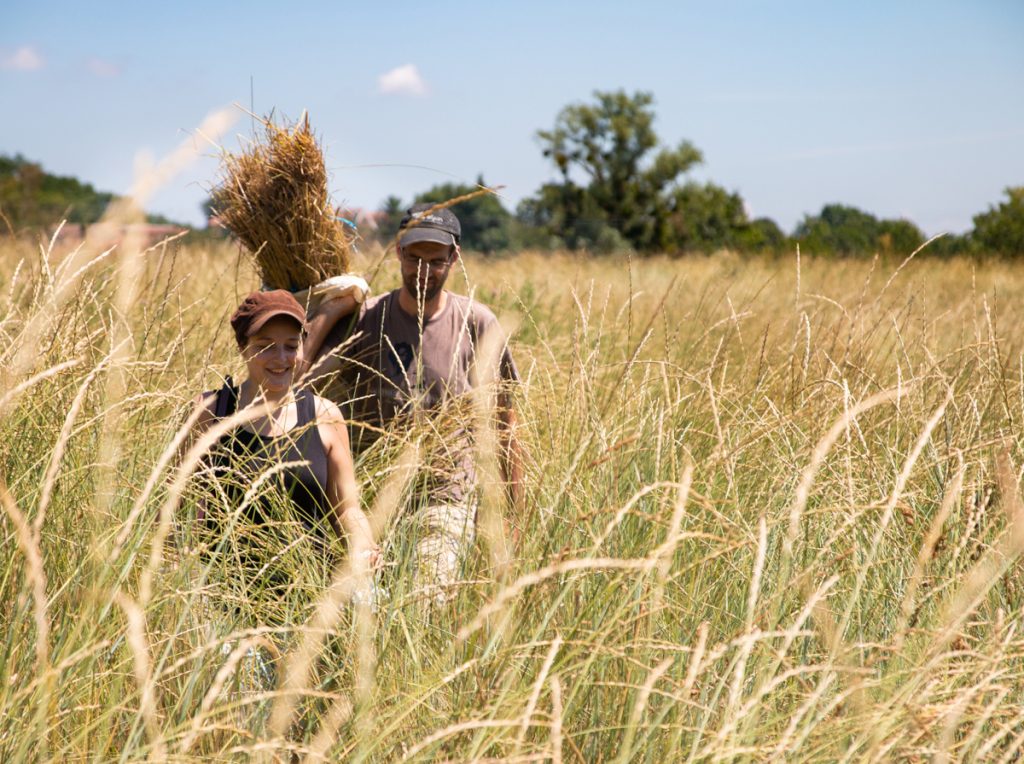
The Agroecology and Sustainable Food Systems programme is aimed at international students with a strong interest in sustainable agriculture and agroecosystem management.
Students will get the opportunity to understand structure and function of complex agroecosystems. They will learn to apply systems approaches in studying, designing and evaluating (agricultural) systems and food production chains, and to develop creative solutions for sustainable farming and food systems.
The programme teaches a multidisciplinary approach in which natural science is combined with social science and economics. Action learning and action research through cooperation with farmers, food system professionals and consumers will shorten the distance between practice and theory.
The proposed programme exploits the strengths of the two co-operating institutes, including specialist knowledge in agroecosystems management and application of agroecological science in real-world situations.